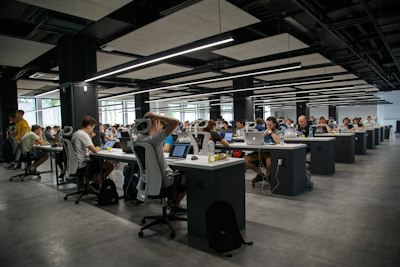
Hot desking — sitting wherever's free rather than having an assigned desk — is the default model at the vast majority of coworking spaces. It's what makes flexible memberships economically viable for both the space and its members. But it comes with real challenges: you can't personalise your setup, you might sit somewhere noisy, and the unpredictability can disrupt your flow.
The good news: with a few deliberate habits, hot desking can actually work brilliantly. Here are seven strategies that make the difference.
1. Arrive early and choose your spot deliberately
In any coworking space, the best seats go to those who arrive first. The quiet corner by the window. The desk away from the main entrance. The spot with the best monitor height. If deep focus is your priority, arriving 15–20 minutes before your ideal start time pays dividends all day.
Learn the layout of your space quickly. Most coworking spaces have quiet zones, collaboration areas, and somewhere in between. Know which zone matches your agenda for that day and head straight there.
2. Build a portable setup you can deploy in 60 seconds
The biggest productivity killer in a hot-desk environment is setup time. If you spend 15 minutes each morning arranging cables, finding a plug, and adjusting your screen, that's over an hour lost per week — and it fragments your focus before the day even begins.
Build a portable kit that goes with you every day:
- A compact laptop stand (foldable ones weigh almost nothing)
- A Bluetooth keyboard and mouse — no cable fumbling
- A short USB-C hub that handles power, display, and data in one plug
- Noise-cancelling headphones — more on those in a moment
- A power strip if you regularly need multiple sockets
The goal is a setup you can unpack, be at full productivity, and pack away again in under two minutes.
3. Use headphones as a focus signal — and mean it
Noise-cancelling headphones are probably the single highest-ROI tool for hot desking. They serve two purposes: they reduce distracting ambient noise, and they signal to others that you're in focus mode.
The latter matters more than people think. In a shared environment, the social norms are set collectively. When you wear headphones, you help establish a culture where people pause before interrupting. Over time, this shapes the whole space's atmosphere.
Be disciplined about when you take them off. Reserve headphone-off time for when you genuinely want to be approachable. This creates clear, unambiguous signals for those around you.
4. Plan your day before you arrive
The transition from home (or commute) to desk is a vulnerable moment for focus. Without a clear plan, it's easy to fill that transition time with emails, Slack, and low-value tasks that never quite end.
Before you leave for your coworking space — on the bus, the night before, wherever — write down your one or two most important tasks for the day. These are your anchors. Everything else is secondary. When you sit down, open your most important task first, before email, before Slack, before anything.
5. Batch your social interactions
One of the best parts of coworking is the community. One of the most productivity-killing parts of coworking is also the community. Unstructured chat can fragment a morning of deep work into useless 20-minute chunks.
The solution isn't to be antisocial — it's to batch your social time. Use the kitchen, the lunch hour, and the end of the day as your windows for conversation and connection. During your focus blocks, treat interruptions the same way you would in a library: polite, brief, and rare.
6. Use the space's zones strategically throughout the day
Most well-designed coworking spaces have different zones for different types of work. Stop treating the entire space as interchangeable.
A good daily rhythm might look like this: arrive and settle into a quiet focus zone for deep work in the morning, move to a slightly more social area after lunch for collaborative or administrative tasks, and use phone booths or quiet rooms for calls. The physical movement itself helps your brain shift gears — it's a low-tech but effective focus tool.
7. Leave at the same time every day
This one surprises people, but it might be the most important tip on the list. Hot-desk environments lack the natural closing signals that a home or traditional office provides. There's no commute forcing you to stop. There's always someone still working.
Set a hard stop time and honour it. Packing up your kit at a fixed time each day reinforces the boundary between work and life — the boundary that many remote workers struggle most with. It also makes your routine predictable, which helps your brain perform consistently.
Browse our directory of verified coworking spaces across Stockholm, Göteborg, Malmö and more. Find your space
The bigger picture
Hot desking works best when you treat it like a professional discipline, not just a convenient arrangement. The most productive coworkers aren't the ones with the best luck with seating — they're the ones who've built habits that make them effective wherever they sit. These seven habits are a strong foundation.