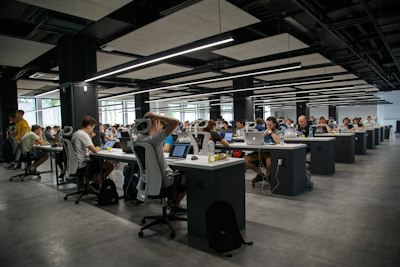
The pandemic made remote work mainstream almost overnight. For millions of workers across Sweden, the kitchen table became the office — and many discovered they actually preferred it. But as the initial novelty wore off, a more nuanced picture emerged: working from home works brilliantly for some people, and terribly for others.
Coworking spaces have quietly filled the gap for those who need something in between — not a traditional office, but not the isolation of home either. If you're weighing up your options, here's an honest comparison.
The case for working from home
Let's be fair: for the right person in the right circumstances, working from home is genuinely excellent. The zero commute alone saves Swedes an average of 50 minutes per day. That's time you can spend sleeping, exercising, cooking, or simply being present with your family.
Home working is also cheaper. The cost of a coworking membership in Sweden ranges from 2,500 to 7,000+ SEK per month — that's money that stays in your pocket when you work from home. And if you've invested in a proper home office setup — a good chair, a large monitor, a quiet room — the productivity argument in favour of going to a shared space weakens considerably.
Sweden's housing stock also tends to be larger than in many European cities, particularly outside Stockholm. In Malmö, Göteborg, Uppsala or smaller cities, it's more realistic to have a dedicated home office room, which removes many of the distractions that plague remote workers in cramped apartments.
The case for coworking in Sweden
The loneliness problem is real. Swedish work culture values independence and autonomy — but humans are fundamentally social creatures. The casual interactions that happen naturally in a shared workspace — the coffee chat, the corridor question, the spontaneous brainstorm — don't happen at home. For freelancers and solo founders especially, this social deficit compounds over time in ways that affect both mental health and professional development.
Boundaries between work and home collapse. One of the most consistent findings from remote work research is that home workers struggle more with overworking, not underworking. When the office is in your living room, it never truly closes. Coworking spaces impose a physical boundary that many people find genuinely helpful.
Internet reliability matters more than ever. Sweden has excellent average broadband, but consumer connections aren't always consistent — particularly in older apartment buildings where infrastructure varies. Most coworking spaces offer enterprise-grade fibre with guaranteed uptime and backup connections. For anyone doing video calls, large file transfers, or cloud computing, this is a practical advantage.
Meeting-ready infrastructure. Client meetings are awkward at home and expensive at hotels. A coworking membership typically includes access to bookable meeting rooms that are clean, professional, and equipped. This alone can justify the cost for anyone who meets clients regularly.
What about hybrid? The Swedish approach
Sweden has become a leader in flexible working, and the most common approach among Swedish remote workers isn't a binary choice — it's a hybrid model. Many people use coworking spaces two or three days per week, working from home on days when they need deep focus and don't have meetings.
This approach is well-supported by the Swedish coworking market. Day passes are widely available, and many spaces offer flexible monthly bundles — 8 days, 12 days, or unlimited — that let you calibrate your usage without committing to a full-time desk.
The tax angle in Sweden
Worth noting: in Sweden, the costs of a coworking membership are generally tax-deductible for self-employed workers (enskild firma, AB) as a business expense. This effectively reduces the net cost by 20–30% depending on your tax situation. Home office deductions, by contrast, are quite restricted under Swedish tax law. Always confirm with your accountant, but this is a meaningful factor in the total cost comparison.
So which is right for you?
- Do you have a quiet, dedicated room at home to work in? If yes, home may work well. If you're competing for space with family or flatmates, probably not.
- How often do you have video calls or client meetings? More than a few per week makes coworking worth considering seriously.
- Do you find yourself feeling isolated or struggling to stay motivated working alone? These are strong signals that a shared environment would help.
- Are you trying to build professional relationships or a network in Sweden? Coworking accelerates this dramatically.
- Are you employed or self-employed? Employees may have less flexibility on how they use the cost, whereas self-employed workers can typically deduct it.
Browse verified coworking spaces across Stockholm, Göteborg, Malmö and beyond — all in one place. Find a space near you
There's no universal right answer. But the good news is that the Swedish coworking market makes it easy to experiment. Book a day pass, try a few different spaces, and let your own experience guide you. Most people know within a week whether it works for them.